Order the POS-terminal
Redesigning the onboarding experience.
Web app
Mobile
PE clients
Overview
Ordering a POS terminal was an offline, human-dependent process. A merchant left a request on the bank’s website, waited for an employee to call back and manually complete a questionnaire with details about business, then waited again while the bank ran its checks before receiving an approval or a rejection. Start to finish, this took ~56 hours on average — and in a market where competitors were moving faster, that delay alone was costing us deals.
But time was only the surface problem. Two deeper failures sat underneath it.
1. Rejection was a black box
The bank’s security department declined applications without sharing a reason with users. Customer support had no visibility either, so they couldn’t explain the decision or help the applicant recover.
The result was a dead end for the customer and ~60% of applications dropping out of the funnel.
2. The last mile was broken
Customers couldn’t choose a convenient branch to collect their terminal, nor request delivery. This pain point surfaced during discovery, it wasn’t on the original brief: ~20% of ordered terminals were never collected, burning operational cost on hardware that never reached a working checkout. Meanwhile, competitors were already delivering terminals directly to merchants’ points of sale.
Services
User Experience, CJM, Blueprint
Client name
Raiffeisen Bank
Team
Product manager, product designer, business analyst
Ok, let`s go step-by-step…
Goals
I framed the work around three outcomes the business and the customer both needed:
Collapse time-to-terminal. Replace the 56-hour, call-centre-dependent process with a self-serve digital flow a merchant could complete unaided across both the web app for sole traders and the mobile banking app.
Turn rejection into a route forward. Work with the security department to replace silent declines with a transparent path: tell merchants exactly what’s needed and let them prove their business activity in-flow — eliminating the dead end driving the 60% drop-off.
Fix the last mile. Let merchants choose how they receive the terminal — branch collection at a location of their choice, or delivery — to stop the 20% no-collection leakage.
Process
1. Discovery
I opened discovery by mapping the stakeholders and running interviews to identify the key open questions we needed answered before designing any digital onboarding — framing the problem space before committing to solutions.
From there, I put together all existing data we already had on the order-and-collection experience: feedback from branches, the contact centre, and social media. Mining what the organisation already knew, cheaply, before commissioning new research, identify patterns fast and pointed us at where to dig deeper.
I then ran a competitor analysis, identifying the strengths and weaknesses that genuinely mattered to our users rather than cataloguing features for their own sake — which is where the branch-choice and delivery expectations came sharply into focus.
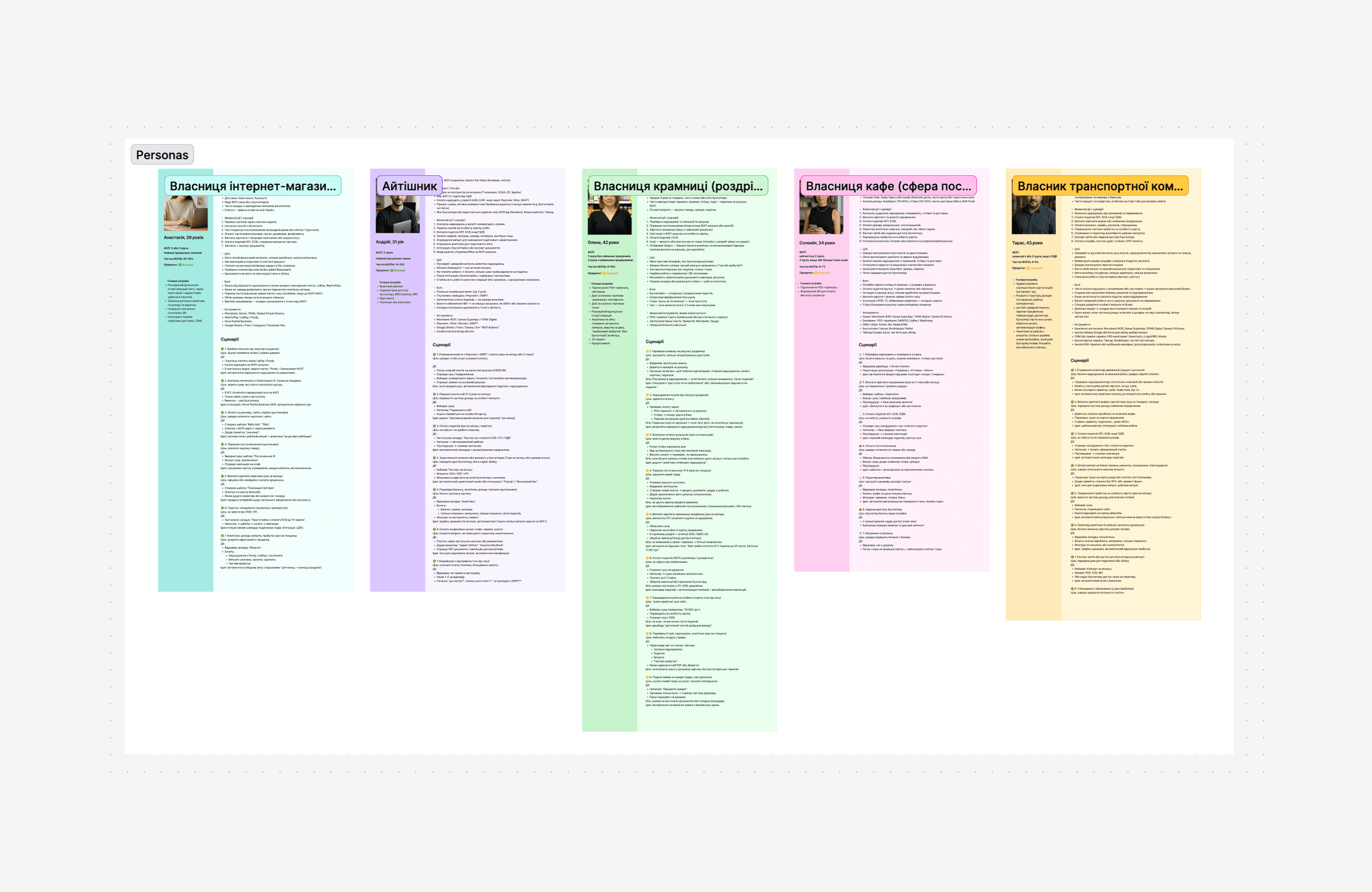
Finally, I built Personas and validated the picture with both an online survey (quantitative) and in-depth interviews (qualitative), to pin down the real pain points and the priority areas for the product to grow into.
2. Synthesis & definition
To turn the research into something we could build, I mapped the Customer Journey Map end-to-end and the Service Blueprint.
It was the Service Blueprint that exposed the real root cause:
the silent rejections and the manual security checks lived behind the interface, in back-stage processes the customer never saw but always felt. Making those steps visible turned an invisible operational problem into a designable one and gave me the concrete basis to sit down with the security department and co-define the additional in-flow verification steps, plus a year-long automation roadmap. The Blueprint didn’t just document the service; it became the tool for changing it across team boundaries.
I then prioritised features with product manager using a Kano-style framework — Hygiene (must-have) / Performance / Nice-to-have — to make scope decisions: what had to ship for the flow to work at all, what would move the metrics, and what could wait. That gave the team a shared, defensible basis for the first release versus the roadmap, before we moved into prototyping.
3. Prototyping & testing
I prototyped directly in high fidelity in Figma, built on our design system, so what we tested was close to the real product experience, not an abstract wireframe, and findings translated straight into shippable UI. The flow went through three design versions as it sharpened.
Testing was iterative, not a one-off check: five rounds of usability testing, five participants each, sampled to cover the different personas.
Five users per round kept each cycle fast; five successive rounds gave us a genuine test → refine → retest loop, with each version validated against real behaviour before it moved forward.
The clearest example of testing changing the design was the business-classification step.
Users had to select their business-activity code (KVED) and activity type, but the codes are defined in law, some of them almost identically, and the list couldn’t be simplified at the data level. So users was frustrated: they’d stop, dig out their documents, and re-read options trying to work out which one was theirs. It was the single biggest point of friction in the flow.
I couldn’t change the regulated data, so I redesigned the path through it:
Smart search so users could find their code by typing, instead of scrolling a dense legal list;
Most-likely codes surfaced to the top, so the common cases were reachable immediately;
The list grouped into business categories, turning a flat legal register into something navigable by how people actually think about their work.
Together these turned the flow’s worst bottleneck into a step users could move through without leaving to hunt for paperwork.
Outcomes & impact
The redesigned flow went live in production in August 2025, across both desktop and mobile, and has run with real merchants since.
Time-to-terminal cut from ~56 hours to ~23 minutes — a fully self-serve, end-to-end journey replacing the call-centre callback and manual questionnaire.
Terminal collection up from ~80% to 98%. Letting merchants choose branch collection or delivery closed the last-mile gap that previously left ~20% of ordered terminals uncollected.
A transparent path through verification, replacing silent rejection. Borderline applicants, previously the bulk of the ~60% drop-off — now receive clear, in-flow steps to prove their business activity instead of an unexplained dead end.
Sustained SUM of 87+% (0–100 scale). Tracked continuously since launch, the Single Usability Metric has held.
Step-level funnel instrumentation driving iteration. Every step of the funnel is measured and the flow changed in response, supported by a triangulated listening system: SUM, structured branch feedback, and analysis of the most frequent contact-centre queries.
User flow & prototypes
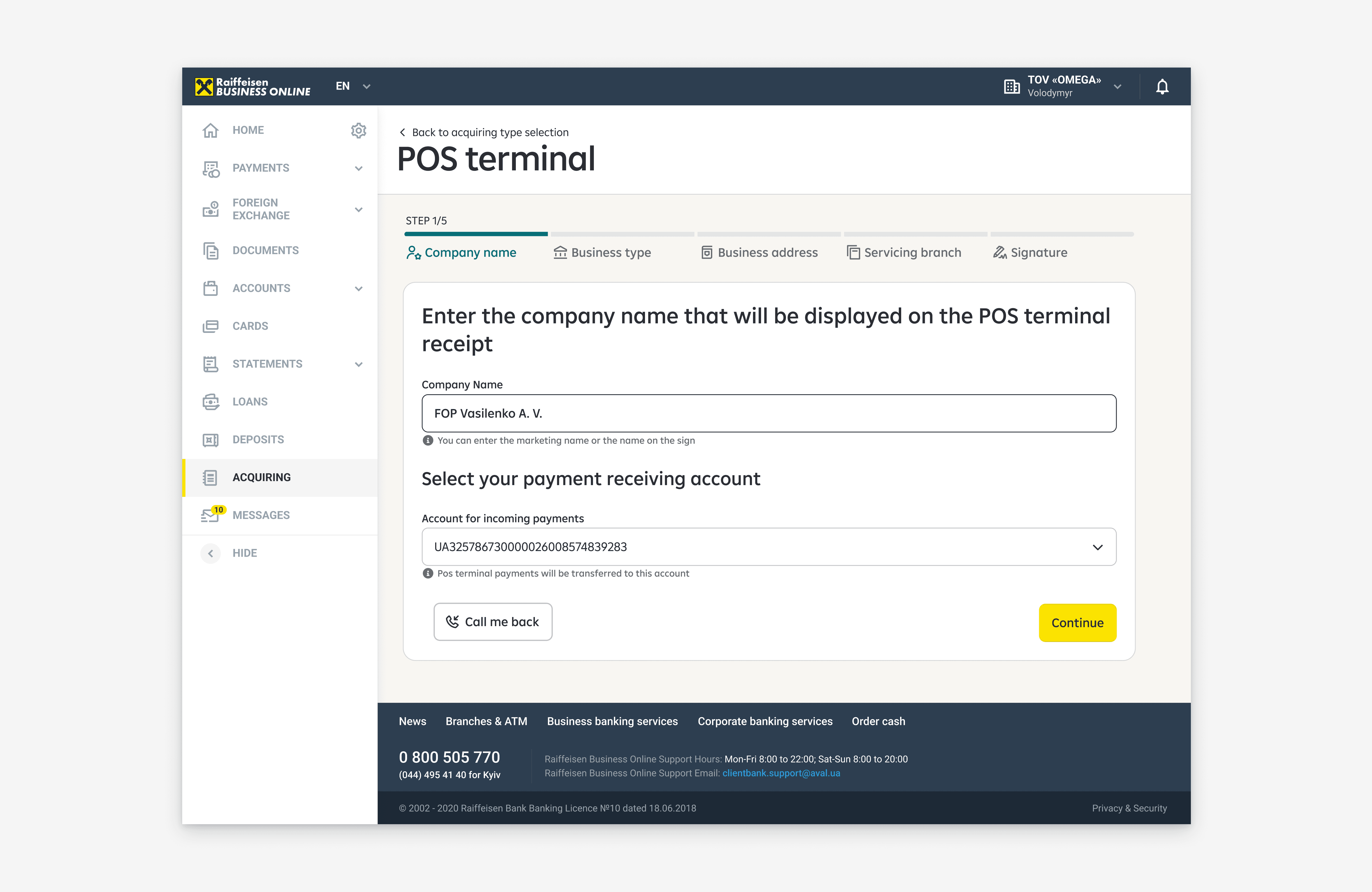
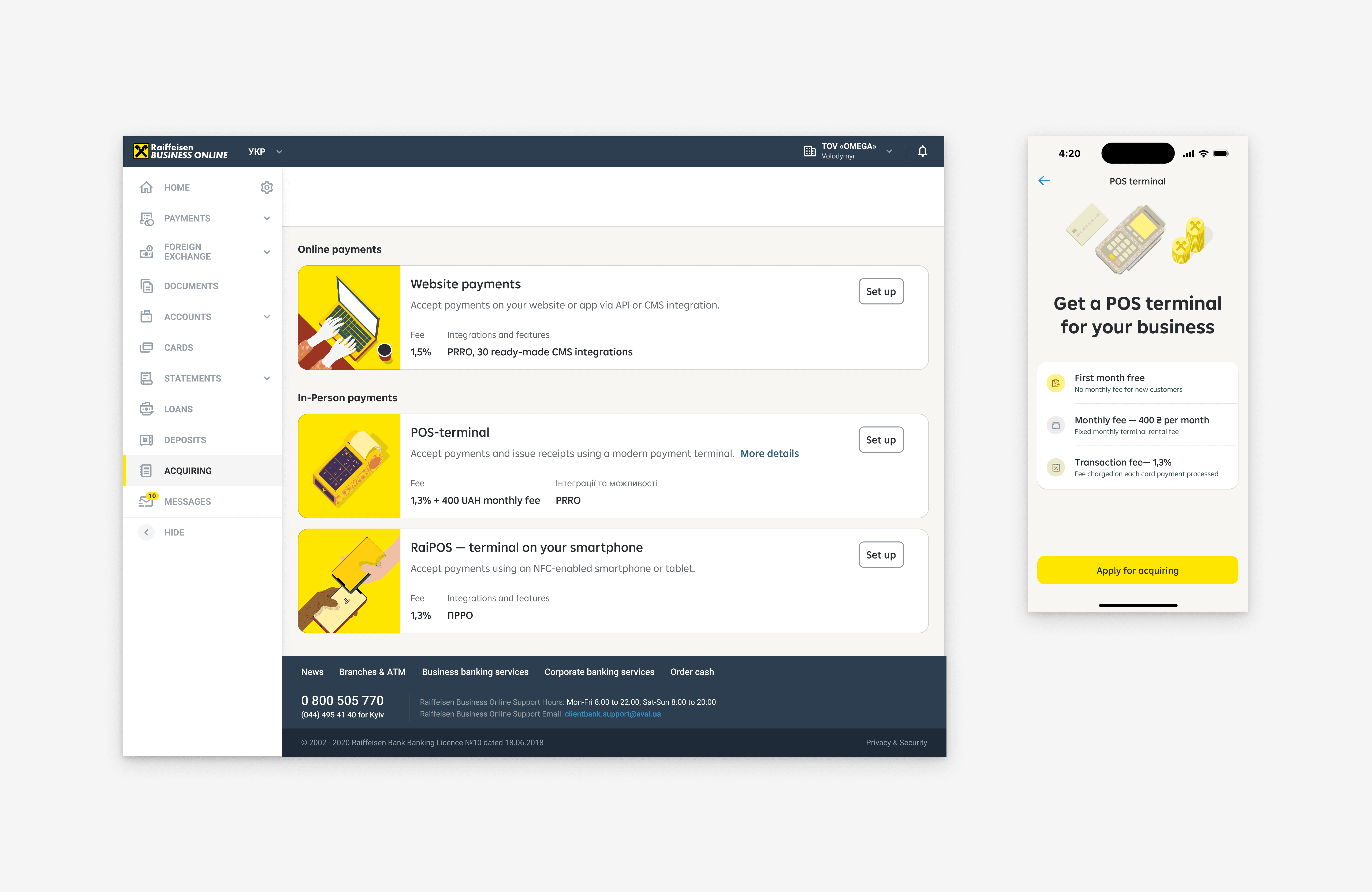
The flow moves through five stages: starting the application unaided, classifying the business, verifying activity, choosing how to receive the terminal, and reaching a working checkout — no callback, no manual questionnaire, no waiting on the bank.
The interactive prototype is best explored in Figma's: Acquiring onboarding
Stats
By focusing on a personalized user experience, the onboarding for POS has become a more engaging, relevant, and productive entry point that successfully guides users through an experience that feels uniquely theirs.
6K
New users
6,000 new merchants reached their first transaction
~146× faster
Time saving
cut time-to-terminal by over 99%
Redesign of the onboarding
Final observations
The biggest lever in this project wasn't on the screen — it was the Service Blueprint. The drop-off everyone could see (a 56-hour wait, a 60% abandonment rate) was really a symptom of decisions happening back-stage, out of the customer's sight: silent security rejections, manual checks, no way to recover. Treating onboarding as a service rather than a set of screens is what turned an invisible operational problem into a designable one, and what gave me the standing to change a process owned by another department rather than just redrawing the interface in front of it.
The second lesson was about constraints. The business-classification step couldn't be simplified at the data level — the codes are fixed in law — so the work wasn't to remove the complexity but to design a humane path through it. That distinction, between simplifying the data and simplifying the journey, shaped most of the decisions that followed.
If I were to take this further, the clearest next step is the verification roadmap we scoped with the security team: automating more of the checks that merchants currently clear manually, so the flow gets faster and the approval rate climbs without loosening compliance. Onboarding, after all, isn't finished at launch — and with step-level instrumentation and a live SUM score already in place, the product is set up to keep earning its 23 minutes.

Alla Hrinina
Lead Product Designer
If you like what you see or have any questions, feel free to send me an email anytime.
Selected work
[2022 -2025]
Order the POS-terminal
Redesigning the onboarding experience.
Outcomes & impact
The redesigned flow went live in production in August 2025, across both desktop and mobile, and has run with real merchants since.
Time-to-terminal cut from ~56 hours to ~23 minutes — a fully self-serve, end-to-end journey replacing the call-centre callback and manual questionnaire.
Terminal collection up from ~80% to 98%. Letting merchants choose branch collection or delivery closed the last-mile gap that previously left ~20% of ordered terminals uncollected.
A transparent path through verification, replacing silent rejection. Borderline applicants, previously the bulk of the ~60% drop-off — now receive clear, in-flow steps to prove their business activity instead of an unexplained dead end.
Sustained SUM of 87+% (0–100 scale). Tracked continuously since launch, the Single Usability Metric has held.
Step-level funnel instrumentation driving iteration. Every step of the funnel is measured and the flow changed in response, supported by a triangulated listening system: SUM, structured branch feedback, and analysis of the most frequent contact-centre queries.